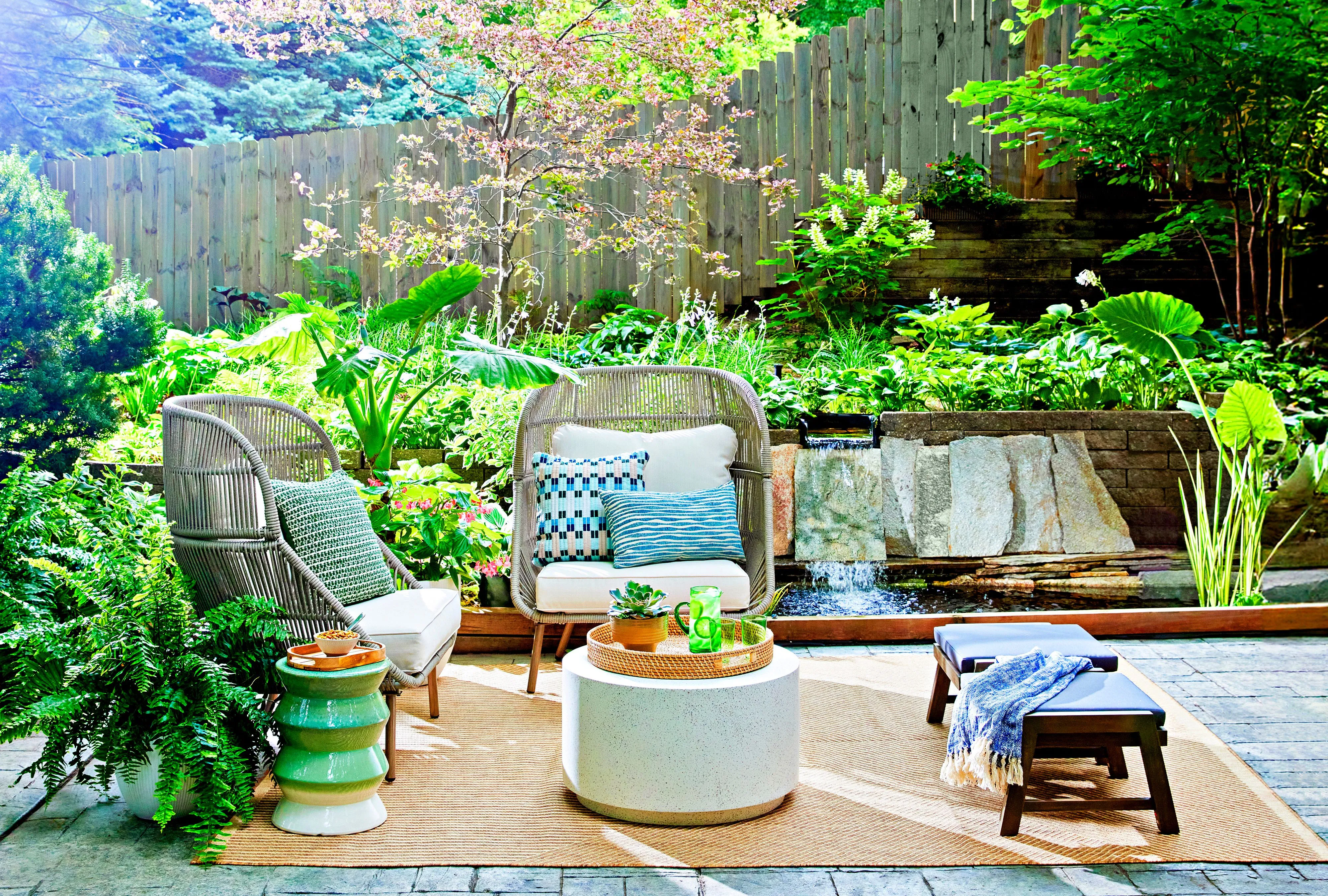
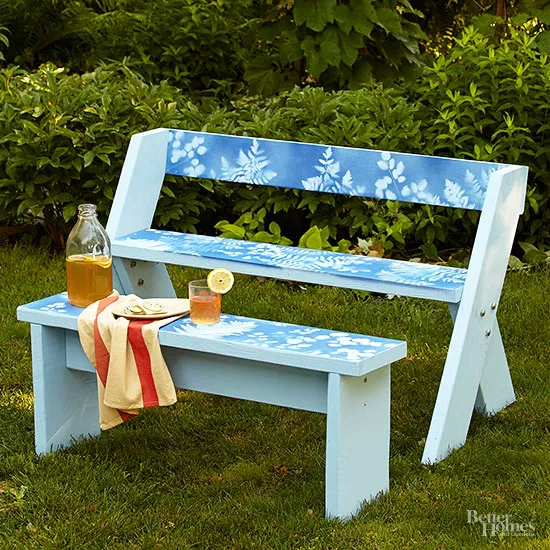
Build this fresh, serene version of the famous Aldo Leopold bench and matching table. This project requires basic woodworking skills, a few tools, and a helper to complete the assembly. All project pieces should be painted with two or three coats of self-priming paint and allowed to dry before stenciling. Let the pieces dry overnight before assembling. It's still a cinch to complete the bench and table over a weekend!
What You'll Need
Equipment / Tools
- 2 sets of sawhorses
- Tape measure
- Straightedge ruler
- Pencil
- Eye and ear protection
- Adjustable bar clamps: 2 of 24-inch, and 3 of 12-inch
- Circular saw
- Paintbrush
- Power drill
- ⅜-inch spade or straight bit, ⅛-inch straight bit
- Screwdriver bits to fit wood screws and carriage bolts
- Hammer
- 9/16-inch wrench or adjustable wrench
Materials
- 8-foot length (2x6) pine lumber
- 10-foot length (2x8) pine lumber
- 10-foot length (2x10) pine lumber
- 100-grit sanding block or sponge
- 6 ⅜-inch x3½-inch carriage bolts
- 6 ⅜-inch washers
- 6 ⅜-inch nuts
- 20 #14 3½-inch wood screws
- Light blue self-priming exterior paint
- Dark blue spray paint
- Fresh ferns and foliage
- Newspaper
Instructions
How to Build a Leopold Bench and Table
-
Get Lumber
Download and print the bench and table plan for the Leopold table and bench and take it to the lumber yard. For easy transport, have the lumberyard cut each board in two pieces as follows: cut the 2x6 and 2x8 exactly in half, and cut the 2x10 at 4 feet 11½ inches from one end. Lay the boards across the sawhorses and mark all the cut lines with a tape measure or straightedge according to the plan. Label each piece with a pencil.
-
Cut and Prep Boards
Don your eye and ear protection. Secure the boards to the sawhorses with the clamps before making cuts with a circular saw. After all the pieces are cut, review how they overlap and join, and mark the fronts and backs of each. Use the sanding block to smooth cut edges and to remove splinters and roughness. Reserve all scraps for use in step 6.
-
Paint Boards
Apply two or three coats of light blue self-priming exterior paint to the Leopold bench and table pieces according to package directions, covering all cut edges, especially the feet of the bench and table.
-
Press Foliage
While the final coat of paint is drying, press ferns and foliage between sheets of newspaper on a hard, flat surface. Lay a spare board or several books on the top sheet of newspaper to flatten and smooth the leaves. Press leaves for two to three hours.
-
Spray Paint Leaves
To spray paint the leaf stencils, choose a well-ventilated work area out of the wind. Lay the bench back, seat, and tabletop pieces face up in that order, from top to bottom, next to each other. Lift the pressed leaves from the newsprint and arrange them across all three pieces. Holding the spray can about 24 inches above the leaves, spray in one-second bursts, covering the whole surface one section at a time. Adjust your height and angle to avoid blowing the leaves away.
Perfection is not the goal here—you're creating a dappled light and shadow effect. Let the paint dry, then discard the leaves.
-
Assemble the Legs
Working on the ground or in a flat area, position one long leg board with one short leg board. Support the pieces with wood scraps to allow space for the clamps and to keep leg pieces lined up properly. Clamp the legs together. Ensure the bottom edges of both leg boards are flush and even by lining them up against a spare board—you want to ensure the legs will sit flat on the ground after assembly. Adjust as needed and clamp firmly.
Pencil in the placement of three holes for the carriage bolts, each about 2 inches apart. Use the ⅜-inch bit to drill the holes. Keep the clamps in place and insert the carriage bolts so the nuts will attach on the inside, under the seat. Hammer the bolts through, then attach the washers and nuts, tightening with the wrench. Assemble the remaining leg pieces to create a mirror image of the first leg. Be sure the short leg boards are on the inside; they will support the seat.
-
Attach Legs to Seat
Stand the two leg assemblies upright, then set the bench seat in place. Have a helper hold the pieces firmly while you drill three evenly spaced pilot holes with the ⅛-inch bit in one end of the seat and into the leg assembly. Be sure not to drill into the carriage bolts. Drive the wood screws in on that end, then repeat the procedure with the other end of the bench seat.
Editor's Tip
It's important to press the drill bit very firmly against the screwhead until the screw is driven in so the screwheads don't become stripped by the bit.
-
Attach the Back
Carefully tip the bench forward. Attach the back by drilling two pilot holes, then drive in the wood screws. Return the bench to its upright position.
-
Add Support Piece
Measure and lightly pencil a centerline on both the inside and the outside of each table leg. Measure and mark the pilot hole placement at 1½ inches from the top and at 4 inches from the top on the outside of each leg. Flip one leg onto its top, and put the table support piece in place on the inside of the leg, using the centerline as a guide. Have a helper hold the support in place while you drill pilot holes on the outside of the leg and into the support. Drive in the wood screws. Repeat with the other table leg. Return the table leg and support assembly to its upright position.
-
Attach Tabletop
Place the tabletop on the table leg assembly. Line up the top so an even amount overhangs the legs at each end. Mark the center of each leg with a light pencil line across the tabletop, then make three evenly spaced marks for the pilot holes. Have your helper hold the tabletop firmly in place while you drill pilot holes in the marks you made on one end of the tabletop. Drive in the wood screws. Repeat at the other end. Carefully wipe or erase your pencil lines from the table legs and top of your Leopold bench and table. Touch up the screw heads with paint if desired.